 EN
 FR
 ES
 DE

Ratio: Word Analogies
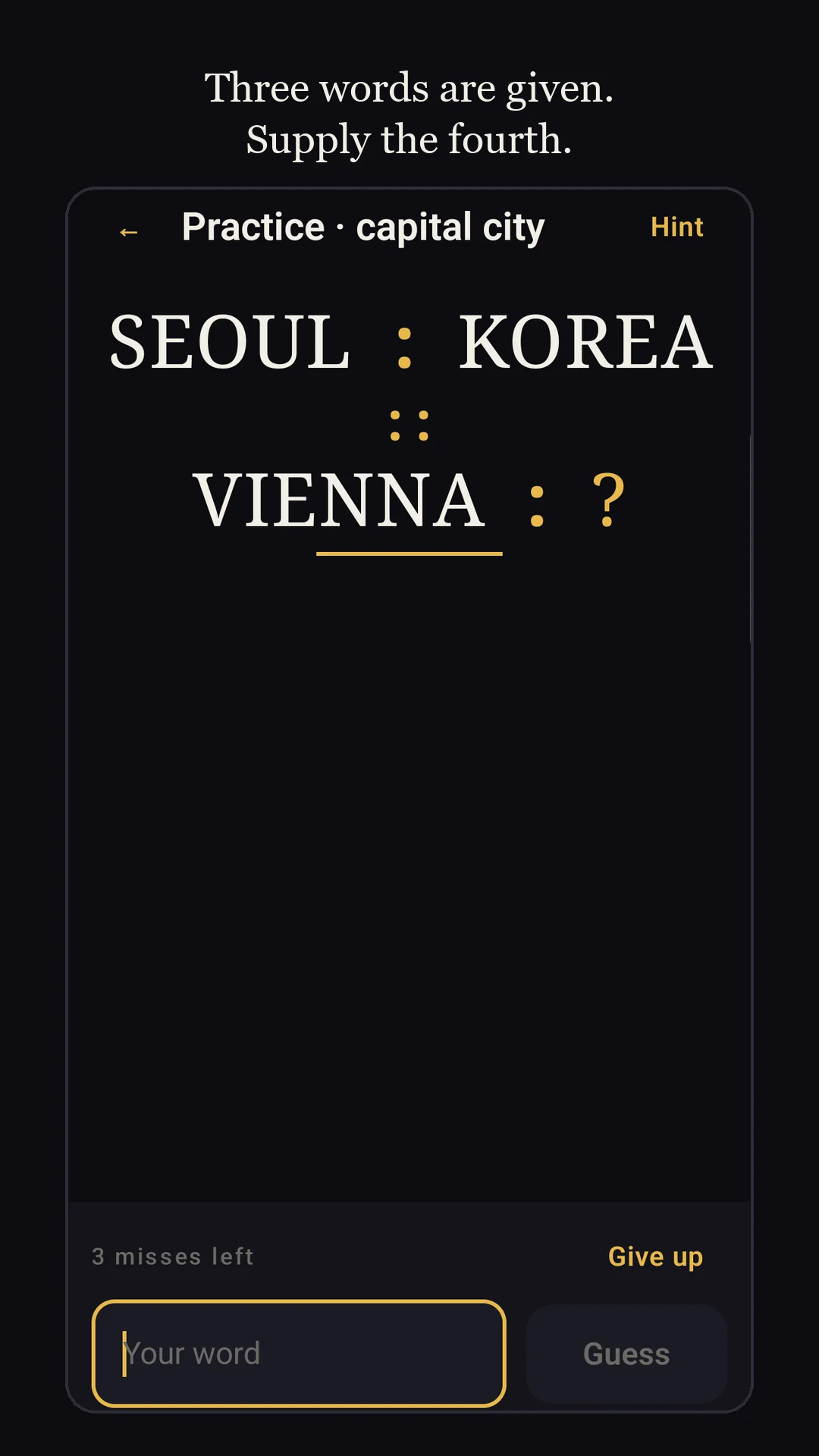
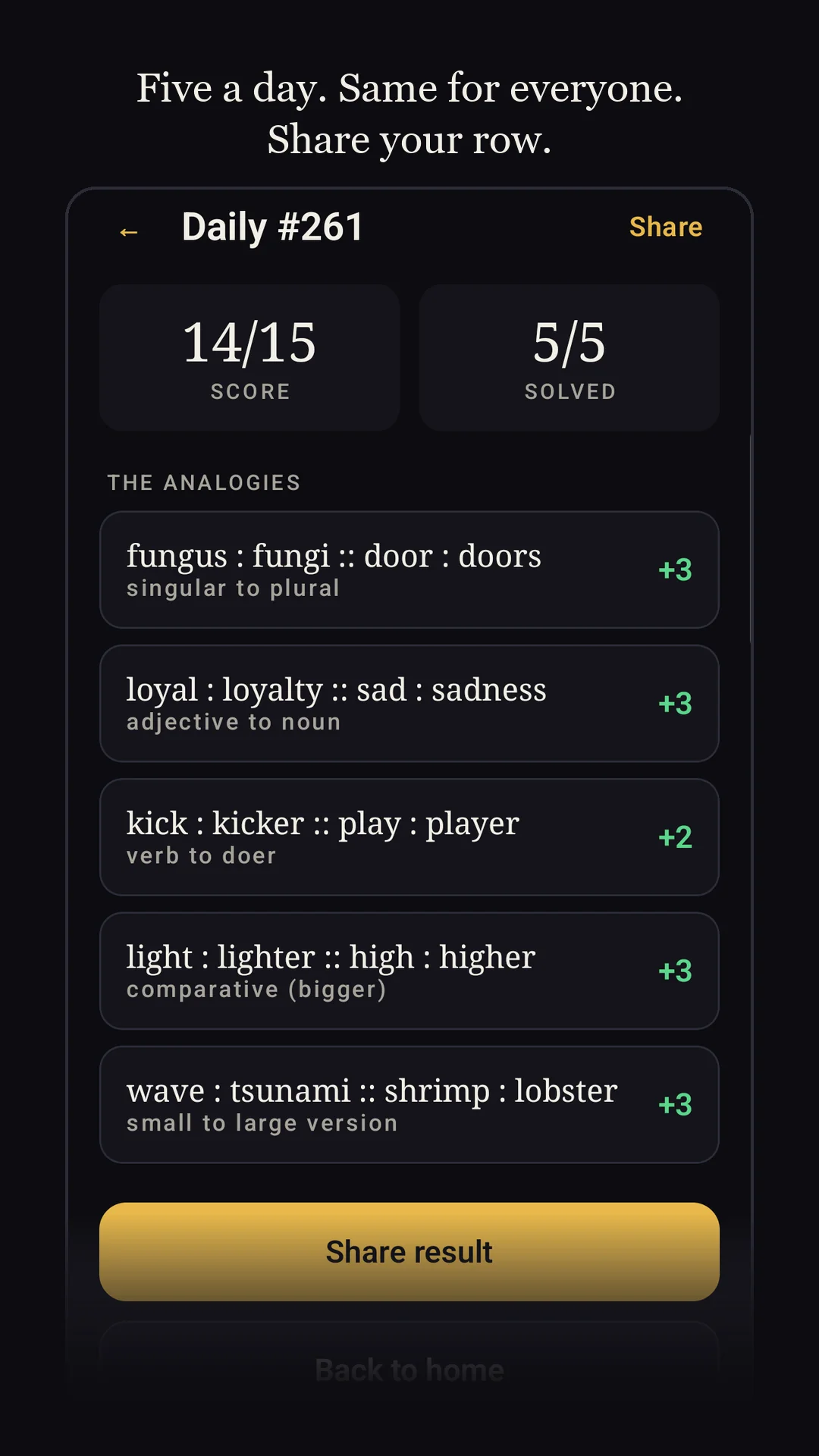
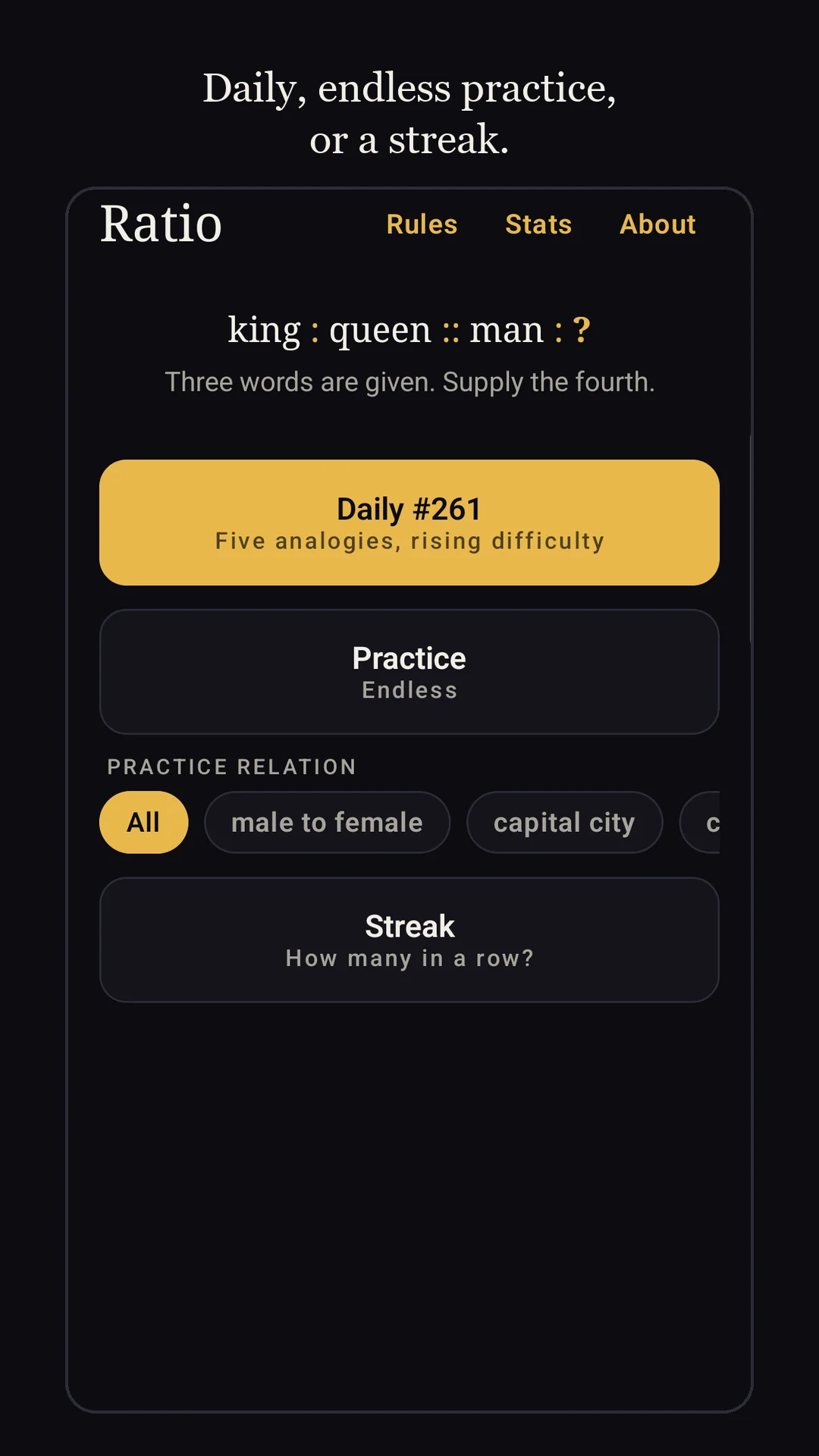
KING is to QUEEN as MAN is to ___. Ratio gives you three words and asks for the fourth. The first pair shows a relationship, and the second pair has to share it. That is the whole game, and it is harder than it looks, because most pairs of words are related in more than one way and you have to see which relation the puzzle means. SEOUL is to KOREA as VIENNA is to — the capital-city one comes quickly. FUNGUS is to FUNGI as DOOR is to — that one makes you stop and think about plurals.
Analogies as arithmetic
Ratio runs on word vectors: a map of 20,000 English words, learned from millions of sentences, in which every word is a point and words used in similar ways sit close together. The useful property of such a map is that relationships become directions. The step from man to woman points roughly the same way as the step from king to queen, so an analogy can be solved by arithmetic: start at the third word, take the step the first pair describes, and see where you land.
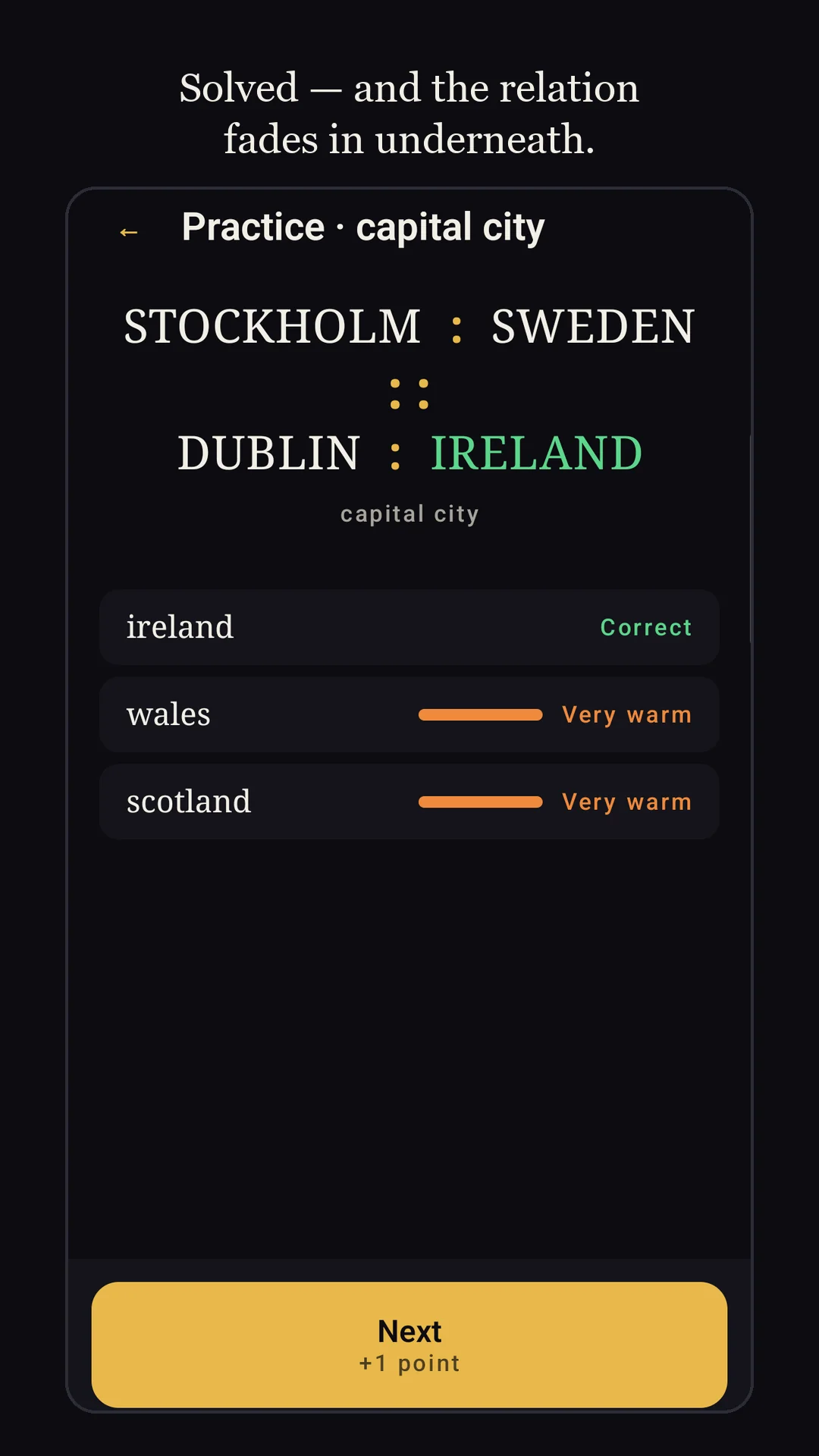
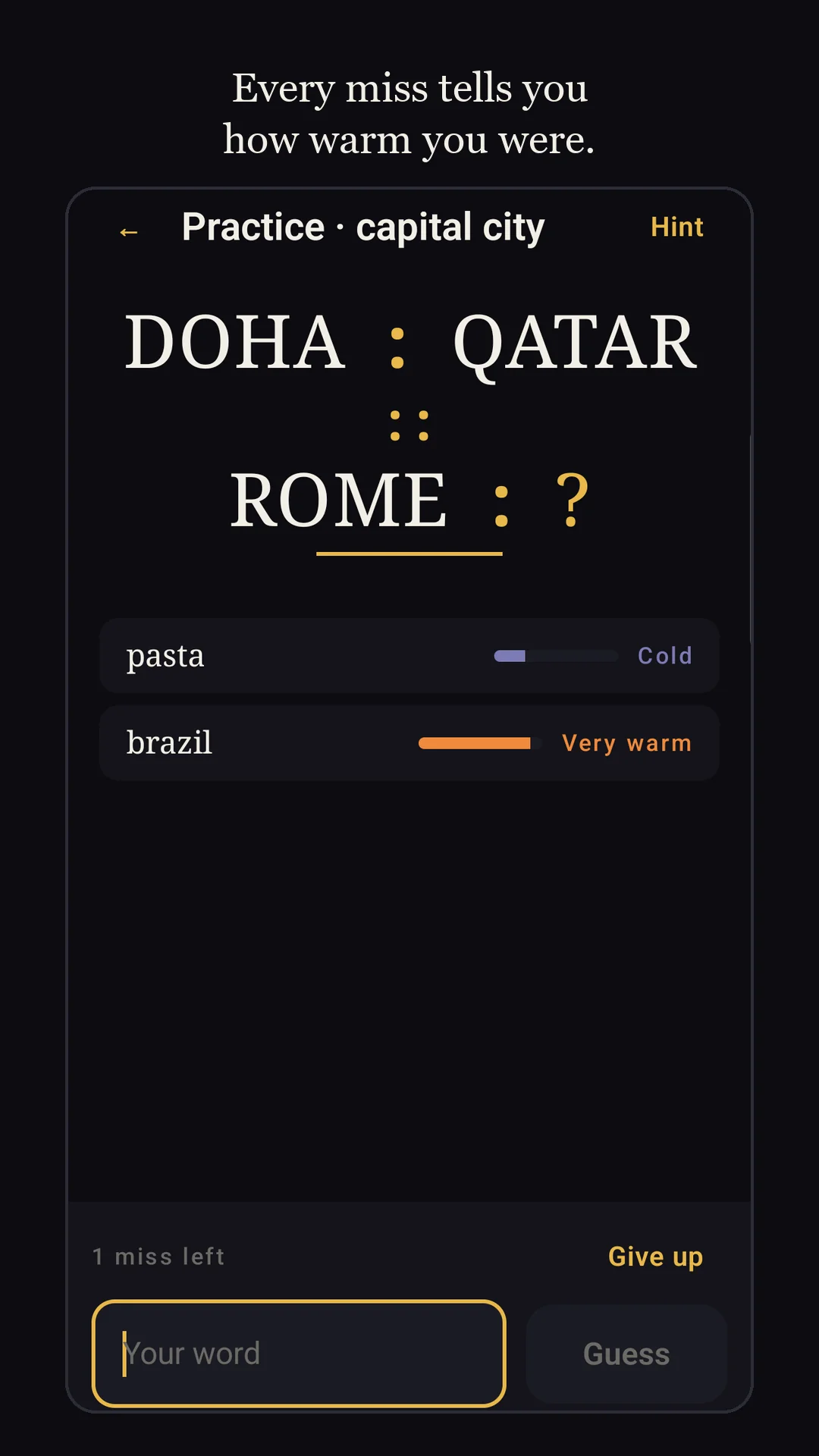
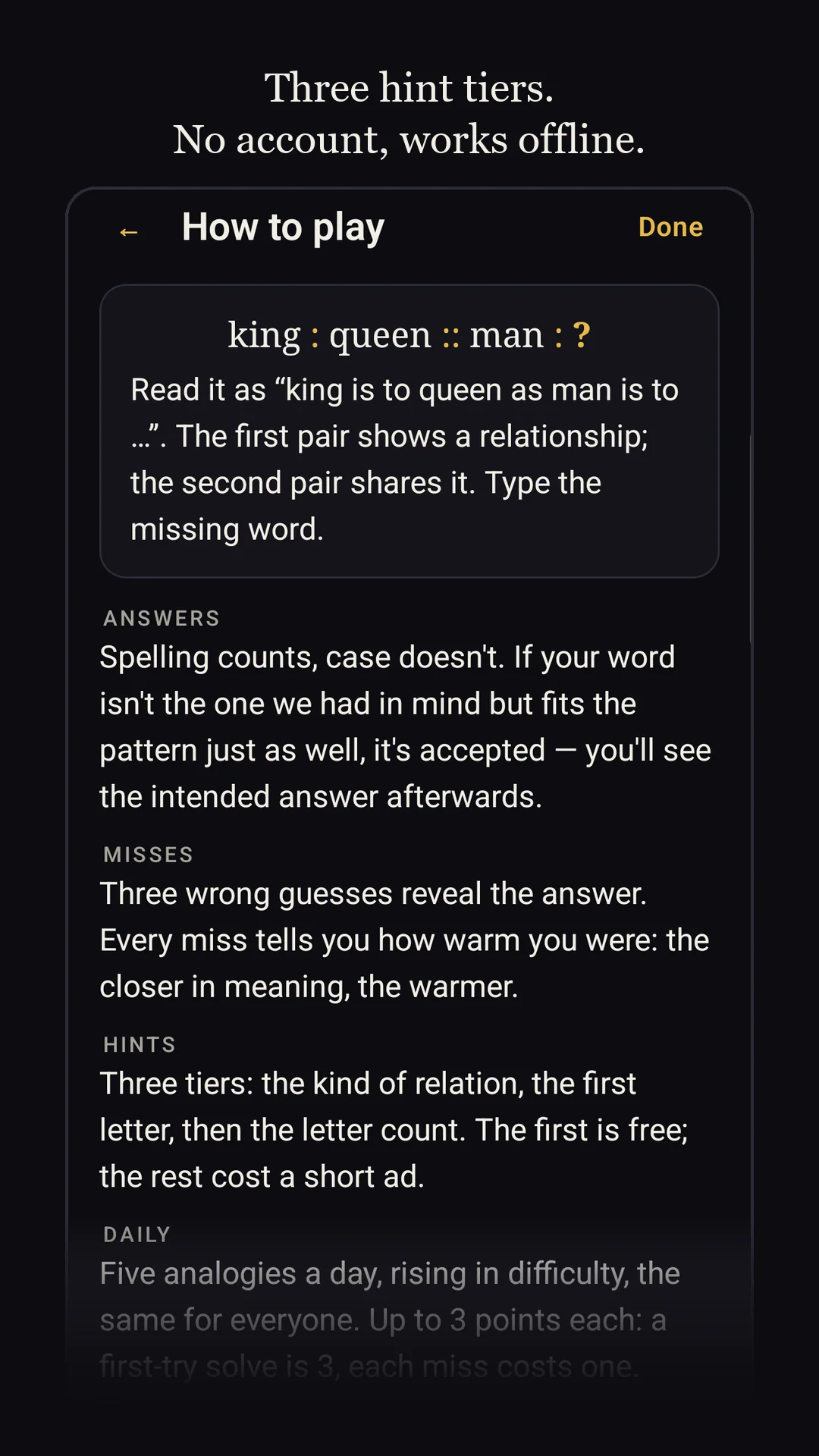
That is also how your answer is judged. The game does not hold one correct word and wait for you to type it; it looks at where your word sits relative to the point the analogy predicts. If it fits the pattern as well as the intended answer does, it counts, and you are shown the answer the puzzle had in mind. If it does not, you are told how warm you were, from cold to very warm, so a near miss tells you which direction to move in. The map ships inside the app, so nothing you type is sent anywhere.
Three ways to play
- Daily — five analogies a day, rising in difficulty, the same for everyone. Each is worth up to three points, so a perfect day scores fifteen, and the result can be shared as a row.
- Practice — endless puzzles, with the option to narrow them to one kind of relation: capital cities, opposites, past tenses, part to whole, worker to tool, male to female and around thirty more. The best way to drill a relation that keeps catching you out.
- Streak — how many analogies can you solve in a row?
There are no timers, no lives and no energy meters. Each puzzle allows three wrong guesses before it shows the answer, and hints come in three tiers: the kind of relation, then the first letter, then the letter count. The first tier is free; the other two are unlocked by watching a short ad.
38,000 puzzles, every one checked
The puzzles come from hand-written relation templates. Each template describes one relationship — country and capital, adjective and noun, verb and the person who does it — and the game builds analogies by pairing two examples of the same relation. That is how one small set of carefully written relations becomes 38,000 puzzles.
A generated analogy is only fair if the map agrees with it, so every single puzzle was tested against the same vectors that judge your answers before it was allowed into the game. A pair that people connect easily but the vectors place far apart would produce a puzzle nobody could get credit for. Anything that failed the check is not in the app: if a puzzle is in Ratio, it can be solved.
Solving well
- Say the first pair as a sentence. “Seoul is the capital of Korea.” Then put the third word into the same sentence and the answer usually falls out.
- Check the grammar. If the first pair goes from singular to plural, or from verb to noun, your answer has to make the same change. Many misses are the right idea in the wrong form.
- Read the warmth. A very warm miss means you are close in meaning; try a variant of the same word before abandoning the idea.
- Take the free hint first. Knowing the relation is “part to whole” or “worker to tool” often unlocks the puzzle without giving away a single letter.
← All games