 EN
 FR
 ES
 DE

Lexis: Guess the Word
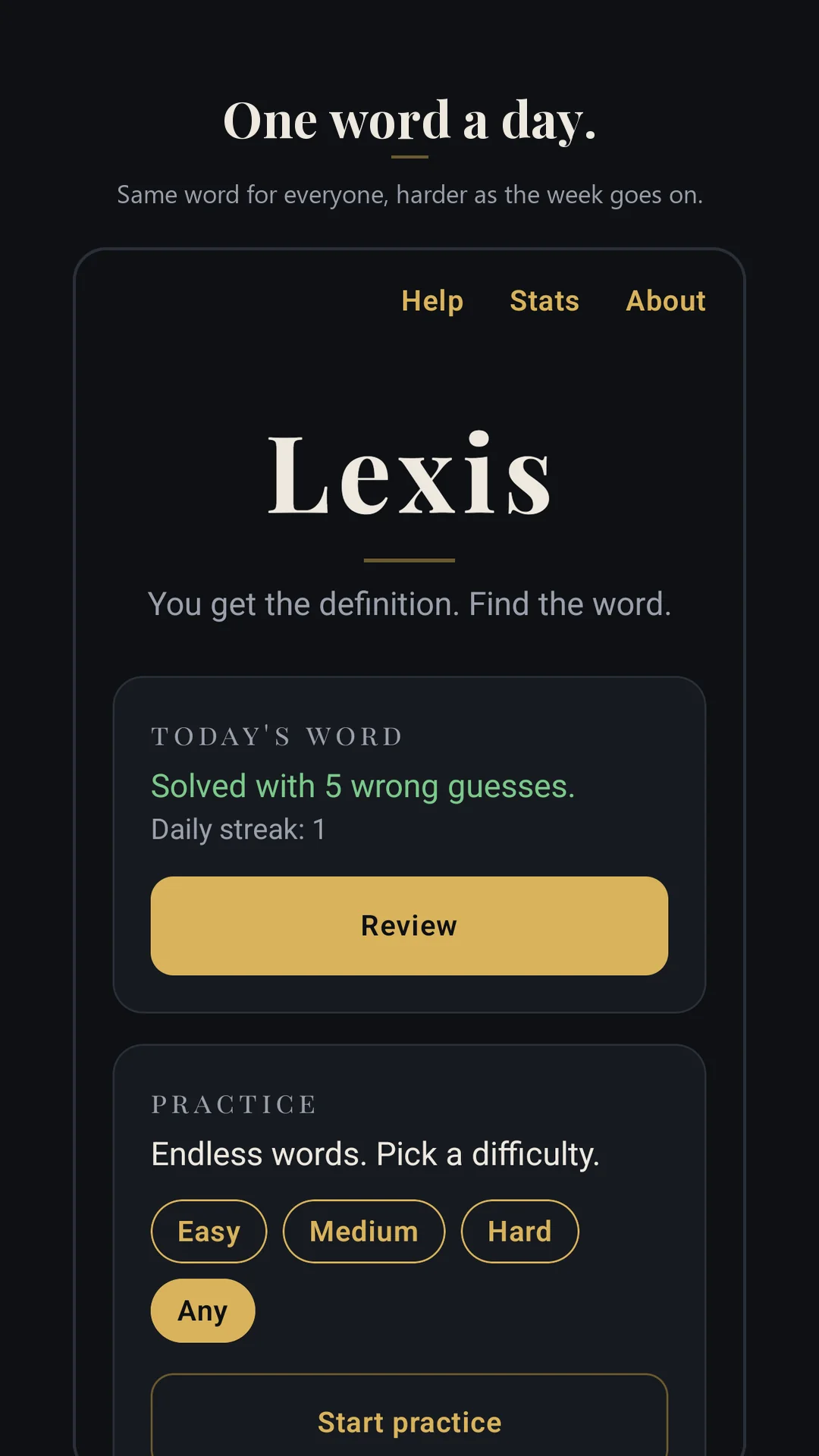
Lexis runs a dictionary backwards. Instead of looking a word up to find its meaning, you are given the meaning and have to produce the word. “A small domesticated carnivorous mammal with soft fur” is CAT, and that one takes a second. Others sit on the tip of your tongue for a quarter of an hour. The whole game is one definition, one answer box, and the particular frustration of knowing that you know a word.
Three ways to play
- Daily — one word, the same for every player. The week has a shape: Monday is gentle and the words grow steadily more obscure towards Sunday. Solving it keeps your streak alive.
- Practice — thousands of words at a difficulty you choose: easy, medium, hard, or anything goes. Nothing is at stake and the streak is not involved.
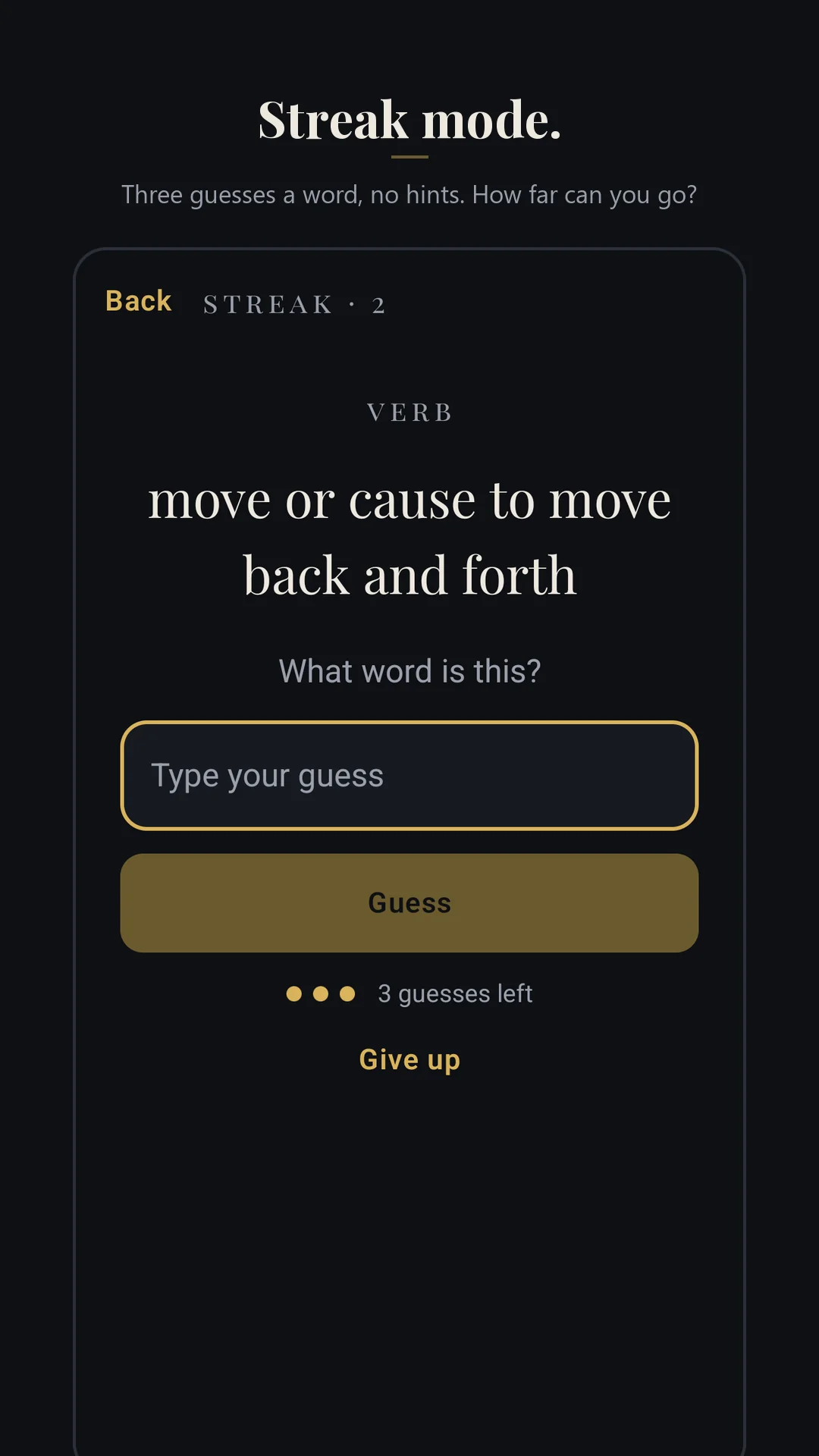
- Streak — three guesses a word, no hints, and the words get harder the longer you last. One miss ends the run.
Where the definitions come from
Every gloss in the game comes from WordNet, the lexical database built at Princeton since the mid-1980s. That provenance matters for a guessing game, because WordNet's definitions were written to be precise rather than entertaining. They describe a word by its category and then its distinguishing features — which is exactly the information you need in order to work backwards. A crossword clue hints and puns; a WordNet gloss simply states, and the puzzle is the recall rather than the decoding.
The raw database is far too large and too strange to drop into a game unchanged. It carries technical binomials, rare senses, and entries whose glosses quietly assume you already know the word. What ships is filtered down to common English words with definitions that stand on their own, and any gloss containing the answer or an inflected form of it is discarded. You will never be shown “a person who bakes” for BAKER.
What counts as right
The thing that ruins a game like this is being marked wrong for an answer that genuinely fits. A definition of a couch describes a sofa just as well, and a game that answers only “incorrect” has quietly turned a language puzzle into mind-reading. Lexis handles that case out loud: guess SOFA when the headword is COUCH and it tells you your answer is a synonym and that a different word is wanted. You keep the information and lose nothing but a guess.
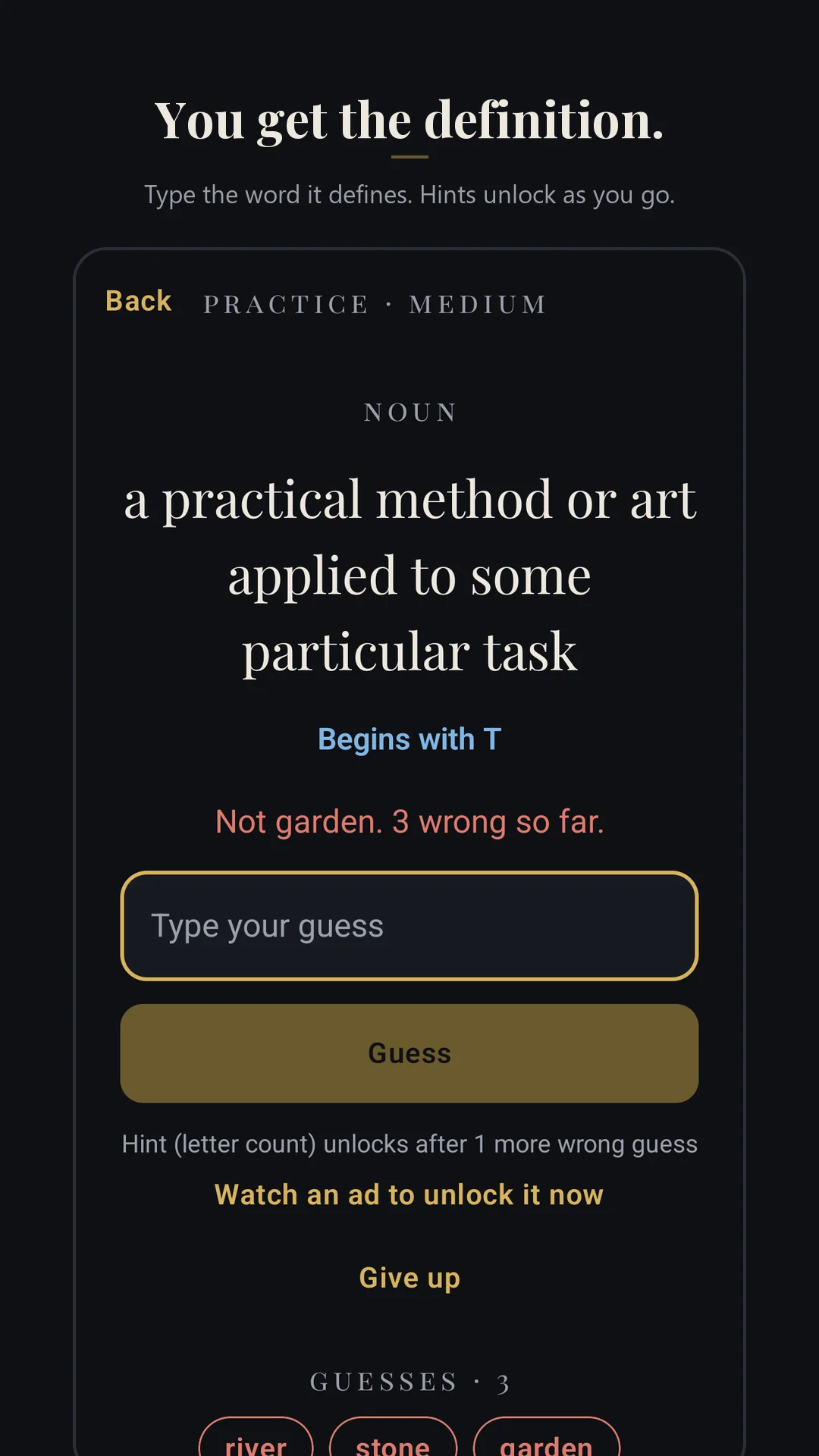
Plurals and simple inflections count, so no turn is lost to an -S. After three wrong guesses the hints open in order — first letter, then letter count, then a second sense of the word — which is usually enough to shake a word loose without handing it over.
Set like a dictionary, not a chat window
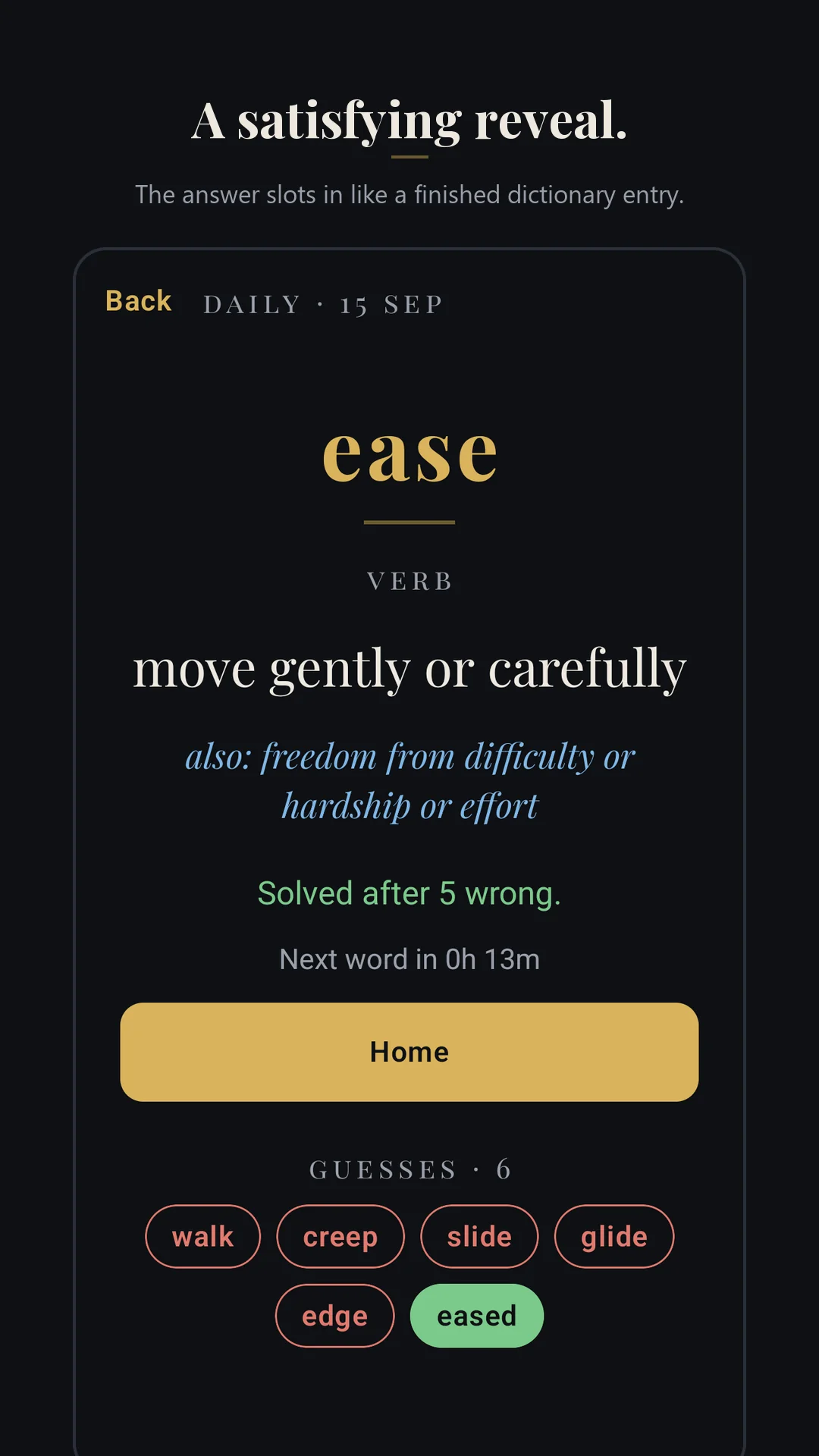
Each puzzle is laid out as a dictionary entry on a dark page: the definition large in a classic serif, the part of speech in small caps beneath it. Get it right and the headword drops into place above its own definition, which is a small thing and the most satisfying moment in the game. The typography is doing work rather than decorating. The same sentence set as a chat bubble reads like a riddle someone is asking you; set as a dictionary entry it reads like a fact you have temporarily misplaced — and that is the feeling the game is after.
← All games