 EN
EN FR
FR ES
ES DE
DE
Proximity: Word Game
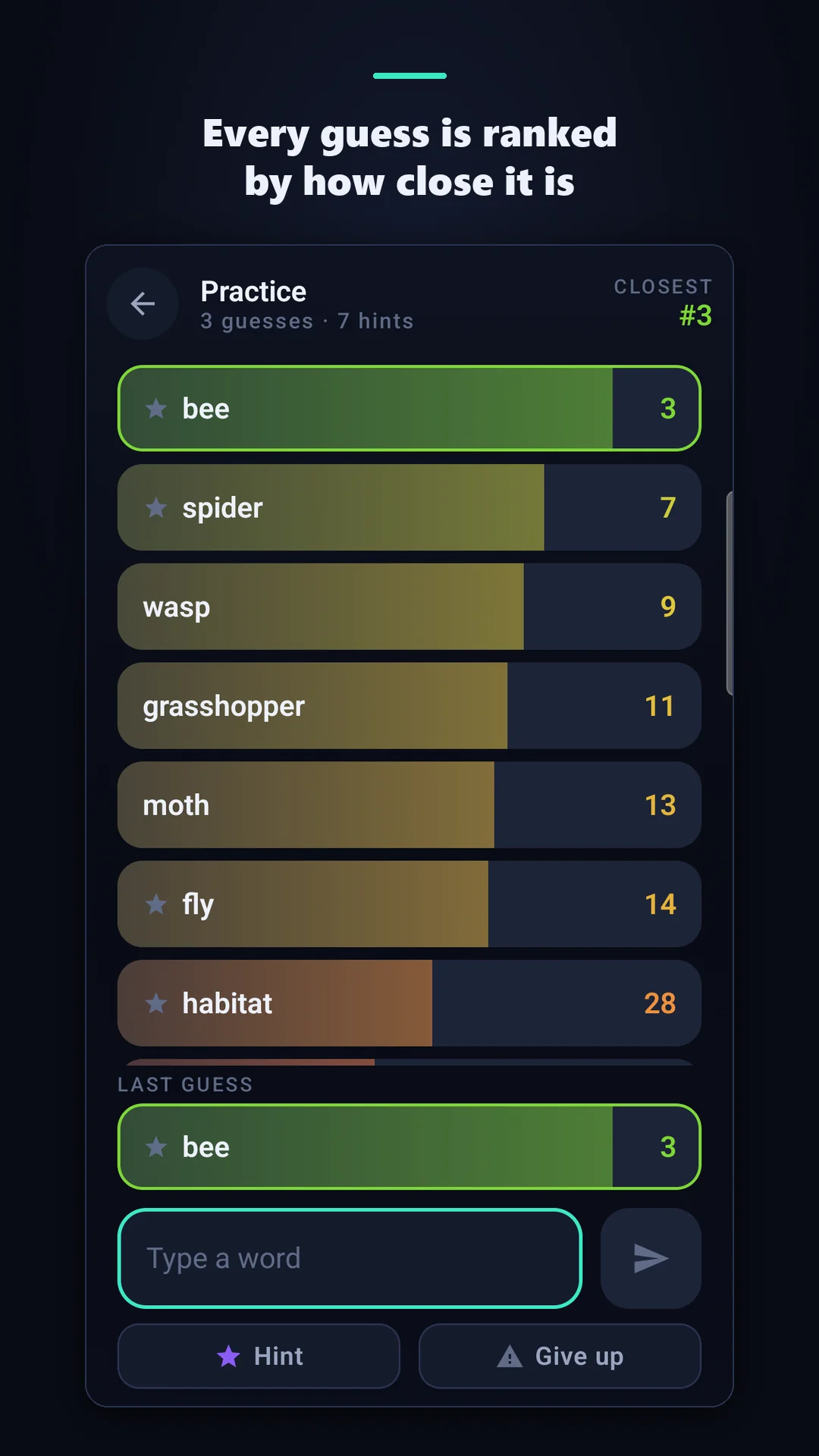
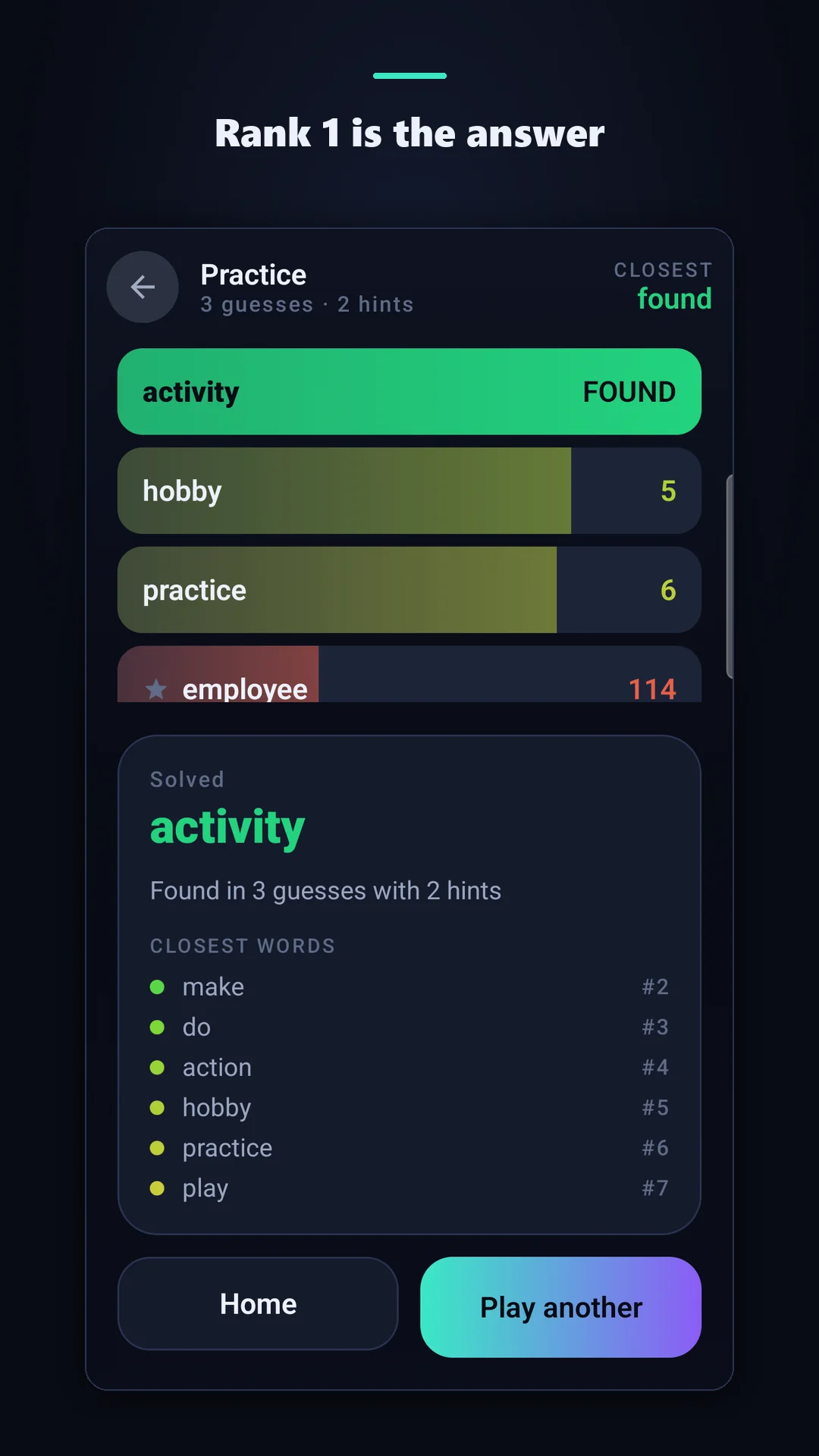
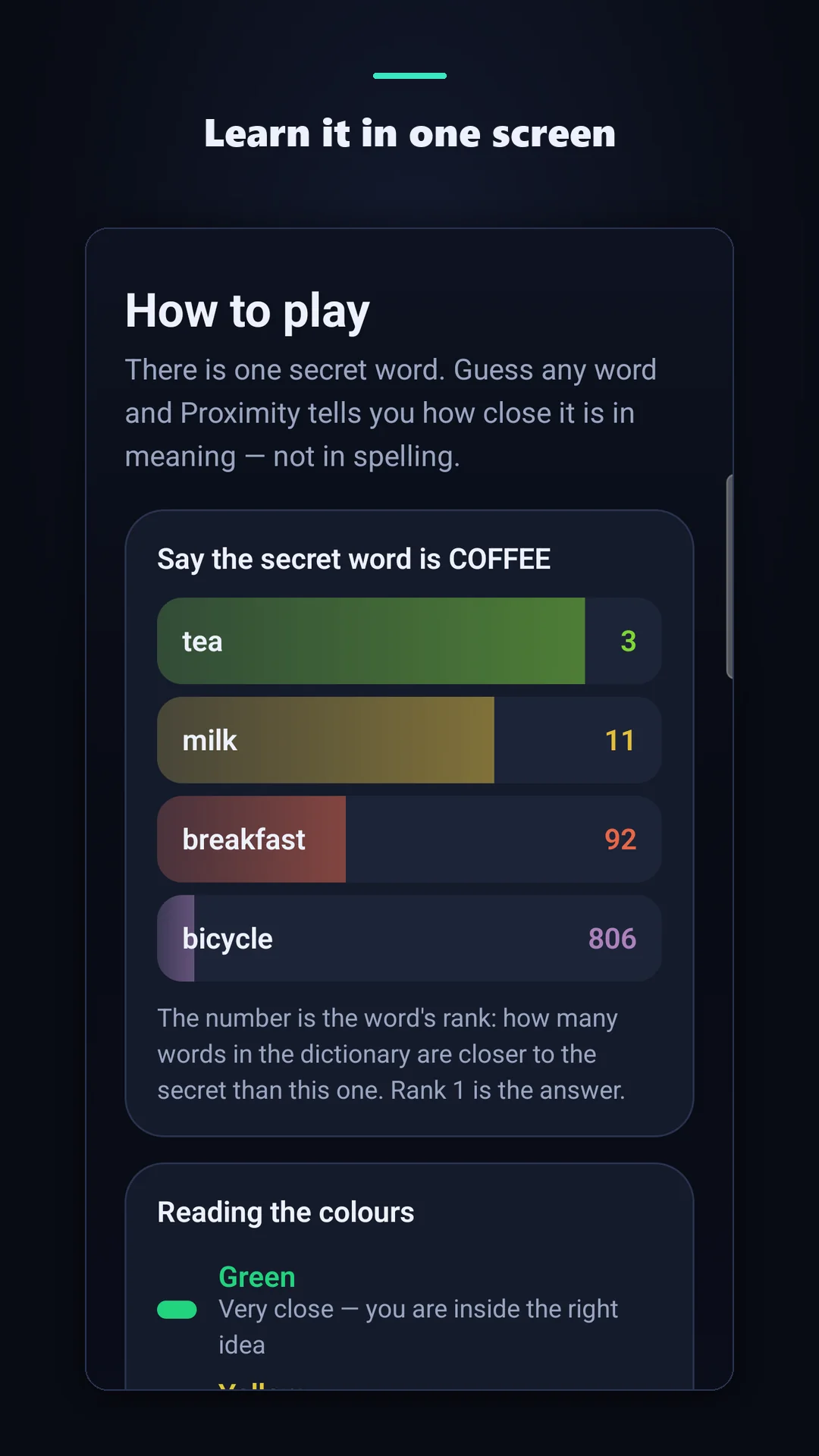
Proximity hides one word and gives you a single kind of feedback about every guess you make: a rank, telling you how close that guess sits to the answer in meaning. Spelling is irrelevant, length is irrelevant, shared letters are irrelevant. Guess tea and you might be told it is the 3rd nearest word; guess bicycle and you might get 806. Rank 1 is the answer. There is no timer and no cap on guesses — the only thing standing between you and the word is how well you can steer by meaning.
How a round works
You type a word. Proximity looks it up in a map of word meanings that ships inside the app, measures how far it sits from the secret word, and hands back a number. The number is a rank, not a distance: it says “this is the Nth closest word in the whole vocabulary,” which is far easier to reason about than a raw similarity score. Each guess is colour-coded on a scale from red (a different world entirely) through yellow (the right neighbourhood) to green (nearly there), and the list of everything you have tried stays on screen, sorted by rank, so you can see the shape of your search.
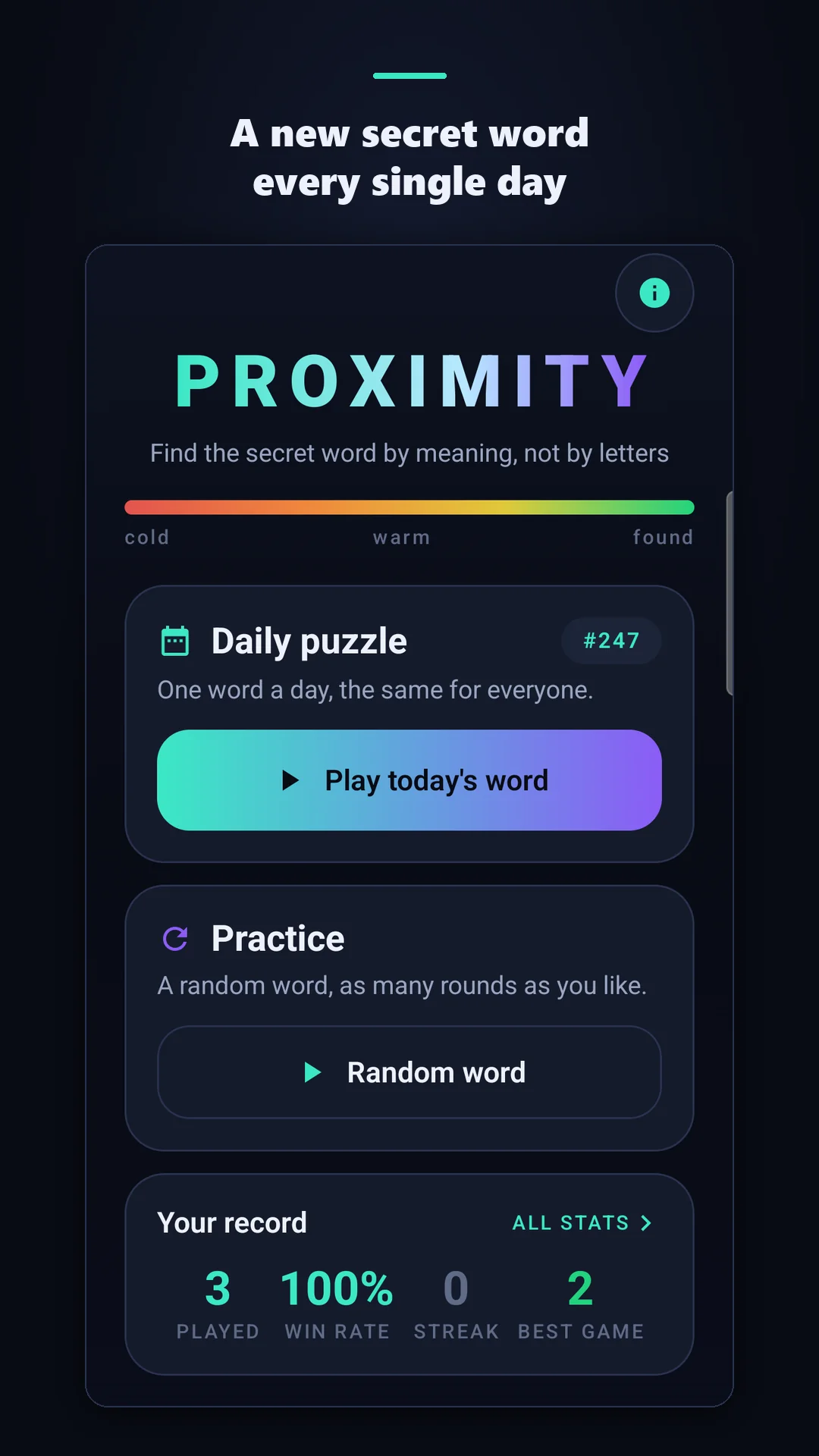
Plurals and common endings are folded together automatically — guessing running is treated as guessing run — so you never lose a turn to grammar. If you close the app in the middle of the daily puzzle, it is exactly where you left it when you come back.
Why the scale is logarithmic
Going from rank 900 to rank 400 feels like progress and, on the colour scale, barely registers. Going from rank 20 to rank 8 is a small numeric change and a big jump in colour. That is deliberate. In a vocabulary of thousands of words, the outer ranks are all roughly equally “wrong” — the difference between the 900th and 400th nearest word is mostly noise — while the inner ranks are where the real information lives. A linear scale would make the first twenty guesses look like steady improvement when they are mostly random wandering, and would compress the last ten into an indistinguishable green. The logarithm matches the colour to where the useful signal actually is.
Playing it well
- Open wide, then narrow. A first guess like animal, building or emotion tells you which region of the map to head for. Specific words early on are wasted unless you already have a hunch.
- Triangulate. Two guesses with ranks of 40 and 45 that point in different directions are more useful than one guess ranked 30. The answer lies somewhere in between, and the next guess should try to split that gap.
- Trust the model, not the dictionary. The map is built from how words are used together, so coffee and morning can be closer than coffee and beverage. Think in associations rather than definitions.
- Use the hint when the ranks stop moving. It reveals a word roughly halfway between your best guess and the answer. Taking it early wastes it; taking it after ten stalled guesses is what it is for.
← All word games